
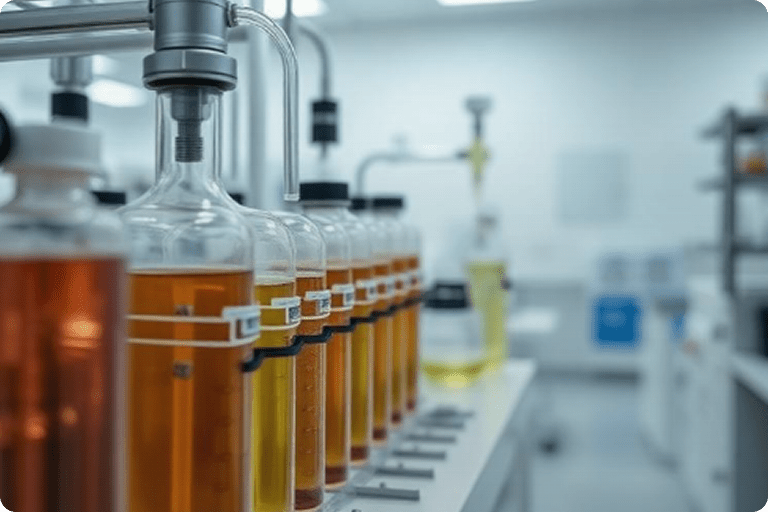
How to produce a chemical that my strain cannot produce?
More often than not, strain engineers face design limits related to toxic, insoluble products or intermediates, potentially topped off with thermodynamic constraints and transport limitations. When the strain’s native metabolism cannot support the target transformation, production could be decoupled into hybrid systems combining fermentation and in vitro biocatalysis.
Aminoverse provides hybrid workflows combining strain engineering and biocatalysis to efficiently circumvent strain-derived limitations while still enabling project success. This approach targets toxic, redox-intensive, or bio-incompatible chemistry steps to improve yield, process stability, and product purity under industrial constraints.
An example is the swap from the P450-mediated oxidation of a hydrophobic substrate causing ROS stress and toxicity in the current host to a hybrid solution:
• Engineered strain optimized for secretion of the stable precursor
• Scalable oxidation reaction mediated by UPOs or KGOs with less expensive cofactors ‘outside’
of the cell
• Improved strain stability and a process achieving 3x higher space-time-yield